1. Which axis is Taj City on?
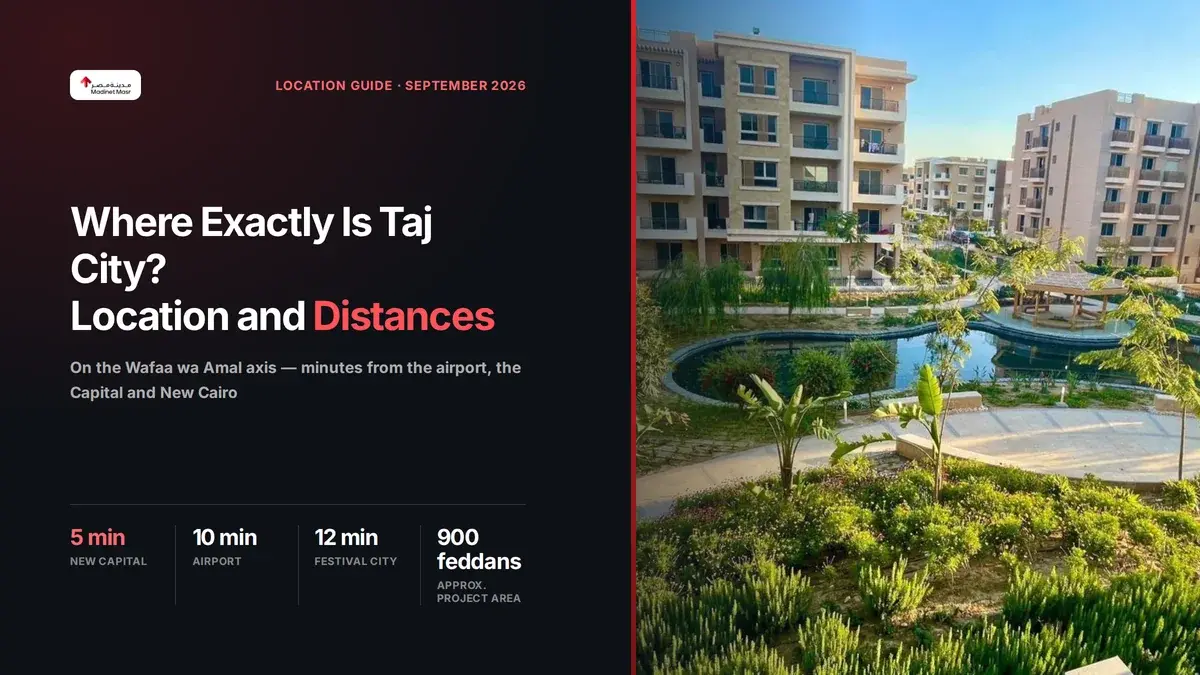
Taj City sits on the Wafaa wa Amal axis, at the entrance to New Cairo from the Suez Road side, and close to the Ring Road.
That position gives it something most New Cairo projects do not have: it is connected to old and new Cairo at the same time. You can reach Heliopolis and Nasr City easily, while still being inside New Cairo's orbit and close to the New Administrative Capital.
The project covers roughly 900 feddans — which makes it less a compound than a small city.
2. The drive times
These are the project's published times to the nearest destinations:
New Administrative Capital — 5 minutes. The shortest figure on the list, and significant for anyone whose workplace is relocating there.
Cairo Airport — 10 minutes. A genuine advantage for frequent travellers and for expatriates who come back regularly.
Korba, Heliopolis — 10 minutes.
Al Rehab — 12 minutes.
Cairo Festival City — 12 minutes.
The American University, Fifth Settlement — 17 minutes.
Maadi — 20 minutes.
⚠️ These times are indicative by nature and vary with traffic and time of day, as with any project. What matters is the relative ordering: Taj City is closer to the airport and Heliopolis than most New Cairo compounds, and closer to the New Capital than most projects in old Cairo.

3. The difference between "close" and "easy to reach"
Many buyers miss this distinction: a project can be close in kilometres but awkward to reach because it sits off a side road or requires a long detour.
Taj City's advantage is that it is on a direct axis, with its entrance off a main road rather than an internal branch. And you can verify that yourself with the simplest possible test: open the maps at rush hour — not at 11pm — and measure the drive from your office and from your family's home. That number is the real one.
4. What exists inside the project?
Published amenities inside Taj City include an international sports club, a hotel, green spaces, gardens and lit streets.
More important than any of that: several phases have already been delivered and are occupied — Taj Sultan, Chalia, Lake Park and Park Residence. That changes the nature of the question entirely.
In a project still under construction you ask "what will be here?" and take the brochure's word for it. In Taj City you can go and see for yourself: whether the roads work, whether the lighting is in, whether shops have opened, whether people actually live there.
Practical advice: visit a delivered phase before buying into a new one. What you see in the delivered phase is the most honest indicator of what will be handed to you.
5. How location feeds into price and yield
Location is not a luxury item — it is a line in the calculation:
Resale value. Units in well-connected locations sell faster, because the pool of potential buyers is wider rather than limited to people commuting in one direction.
Rental yield. Proximity to the airport and the New Capital widens the tenant base (employees, expatriates, companies), which shortens the empty gaps between tenancies.
Your daily cost. The most commonly forgotten item: a 20-minute difference each way is roughly 170 hours a year — a full week of your life in the car, before counting fuel.
Conclusion
Taj City sits on the Wafaa wa Amal axis across roughly 900 feddans, 5 minutes from the New Capital, 10 from the airport and 12 from Festival City — a point that links old Cairo to new, which is what separates it from most projects in the area.
And more importantly, it is not a project on paper — there are delivered phases you can visit and judge for yourself.
You can see every Taj City phase with its pricing, the detail of the final residential phase starting at EGP 6,250,000, and if you are weighing it against another project, Taj City or Sarai?.
Book a site visit and see it yourself before you decide.