1. What certificates really pay in August 2026
The Central Bank of Egypt held its main policy rate at 19% on 20 August 2026 — the fifth consecutive decision to keep rates unchanged. Deposit products at the major banks currently follow accordingly.
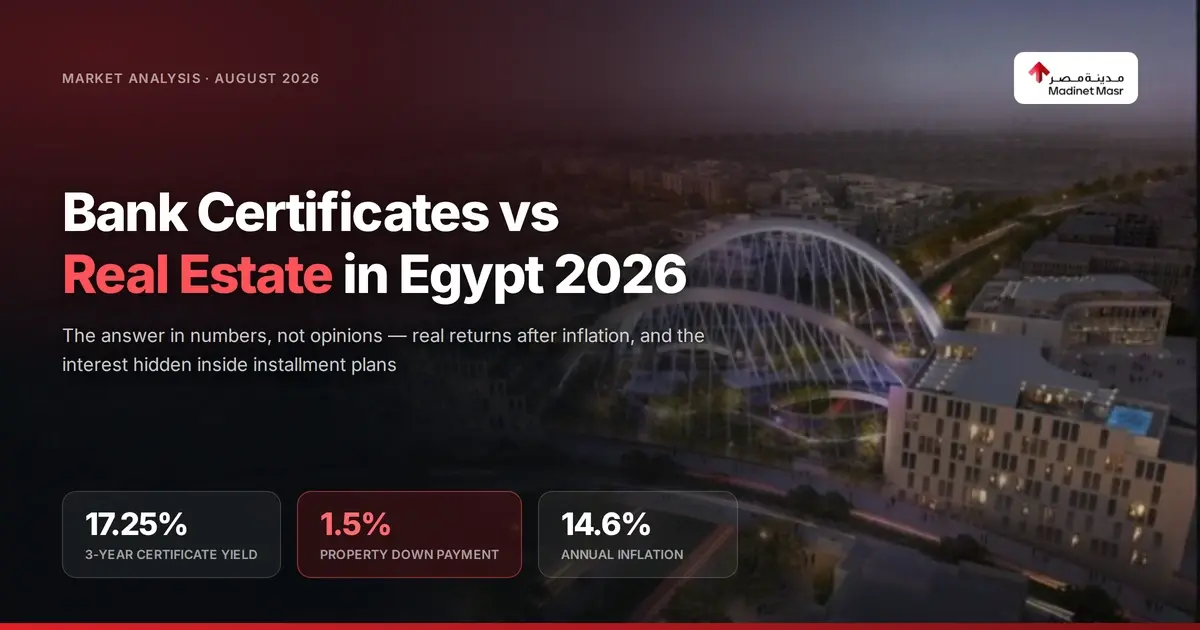
The three-year fixed-return certificate at the National Bank of Egypt pays roughly 17.25% annually, disbursed monthly. The tiered "platinum" certificate opens at 22% in year one, drops to 17.5% in year two, and settles at 13% in year three.
That opening 22% is the number that sells the product. But average the three years and you land at roughly 17.5% — essentially identical to the fixed certificate. The bank is not paying you more; it is paying you earlier.
2. The number that halves your return
Here is the part that rarely makes it into the conversation. A certificate yield is a nominal figure. To know what you actually earned, subtract inflation.
Egypt's annual inflation rate currently sits at roughly 14.6%. So:
Your money earns 17.25% a year while its purchasing power falls 14.6% a year. Your real gain is approximately 2.3% per year.
On EGP 1,000,000 that means a nominal return of EGP 172,500 — and a real gain of around EGP 23,000. Not a loss. Not an investment either. It is closer to "you kept what you had" than to "you grew what you had."
Which is exactly what a certificate is designed to do. It is a capital-preservation instrument, not a growth instrument. And in a year when inflation rises or the policy rate falls, that 2.3% margin can evaporate entirely.
3. The risk that matters most if you earn abroad
If you are transferring money into Egypt from the Gulf, Europe or North America, there is a second layer the local conversation ignores: a certificate pays you in Egyptian pounds.
That means the real question is not whether you earn 17.25% in EGP. It is whether 17.25% in EGP outpaces any movement in the exchange rate over the life of the certificate. If it does not, a locally impressive return becomes a loss in the currency you actually earn in — a scenario a great many diaspora savers have already lived through in recent years.
Property behaves differently. A physical asset in a supply-constrained city is priced by local replacement cost — land, steel, cement, labour — all of which reprice upward when the currency moves. It is not a perfect hedge, and it is not instant. But it does not sit still while the currency slides, and a certificate does.
4. Property returns come from three directions, not one
The common mistake is comparing a certificate yield against price appreciation alone. Property actually generates return three separate ways.
Capital appreciation. The volatile component. It surged through 2022–2024 alongside the currency float, then cooled markedly in 2025–2026 as the pound stabilised and inflation eased. Anyone telling you Egyptian property doubles every two years is describing an exceptional window, not a rule.
Rental income. The overlooked component, and currently the strongest: JLL's Q1 2026 research puts annual rental growth across Egypt's new cities at 10% to 11%. That is monthly income that rises every year without you selling anything.
The cash discount. The component almost nobody calculates correctly — which is what the next section is about.
5. The calculation that flips the decision
Take a real market example: a unit priced at EGP 3,600,000 on a 12-year installment plan with a 1.5% down payment.
Scenario A — you hold EGP 3.6M in a certificate.
Annual return = 3,600,000 × 17.25% = EGP 621,000 per year, or about EGP 51,750 per month.
Scenario B — you keep the same EGP 3.6M in the certificate and buy the unit on installments.
Down payment at 1.5% = EGP 54,000. The remaining EGP 3,546,000 over 12 years works out to roughly EGP 295,500 per year, or about EGP 24,600 per month.
Compare them: the certificate pays EGP 51,750 a month. The installment costs EGP 24,600 a month.
You service the installment out of the certificate's income, keep roughly EGP 27,000 a month in your pocket, leave your EGP 3.6M principal completely untouched — and you now own an asset.

The obvious follow-up: why is developer financing that cheap? Because developers offer cash discounts of up to 54%, and in some cases 64%, for immediate payment. That discount reveals the interest rate hidden inside the installment plan: if the cash price is around 46% of the 12-year installment price, the implied annual rate the developer is charging you works out to roughly 15% to 16% per year — meaningfully below the certificate yield.
The financial principle is old and simple: while your capital earns more than your financing costs, financing is the mathematically correct choice — even when you could pay cash outright.
For the plans currently available and which ones carry the lowest entry cost, see the lowest down payments in New Cairo compounds.
6. Where property genuinely loses
If this article stopped at the section above it would be marketing, not analysis. So here is the other side.
Liquidity. A certificate can be broken today and settled the same day, at the cost of some accrued return. A unit can take months to sell, and secondary-market activity in Cairo has been subdued through 2026.
Delivery risk. You are buying something that does not yet exist. A four-year delivery window is four years with no rent, no use, and no return.
Hidden costs. Annual maintenance charges, finishing costs where a unit is delivered semi-finished, and registration fees. These meaningfully reduce net yield, particularly in the first two years.
Market cycles. Official Egyptian house-price data in 2026 shows a clear slowdown after several years of sharp gains. Buyers who entered in 2022 did very well. Buyers entering in 2026 are entering a calmer, more rational market — and should price their expectations accordingly.
7. When the certificate is the right answer for you
There are real cases where the certificate wins, and no salesperson will volunteer them.
If this money is your safety net and you may need it within a year or two. If you are retired or dependent on a fixed monthly income and cannot wait out a delivery period. If the amount is too small to secure a down payment on a unit in a location worth owning. Or if market volatility genuinely costs you sleep — which is a legitimate reason, not a weakness.
A certificate is an excellent tool for its purpose. The problem only begins when it is used as a ten-year growth strategy, which was never its job.
Conclusion: the real answer is "both", not "either"
The sharper framing is not property versus certificates. The approach most experienced investors in the Egyptian market use today is a combination:
Leave your capital in a certificate generating monthly income, and use part of that income to service installments on a unit bought with a small down payment. Your capital stays preserved and productive, and you gain exposure to a hard asset without draining your balance.
Which turns the practical question into a much better one: what is the smallest down payment that gets me into the market without touching my capital?
You will find the answer in the complete guide to Sarai Compound prices, and across the projects with down payments starting at 1.5% — Sarai Compound in New Cairo and Butterfly Compound in Mostakbal City.
For questions on down payments, refunds and cash discounts, most answers are in our FAQ — or request the current price list and we will send it over with the full payment terms.