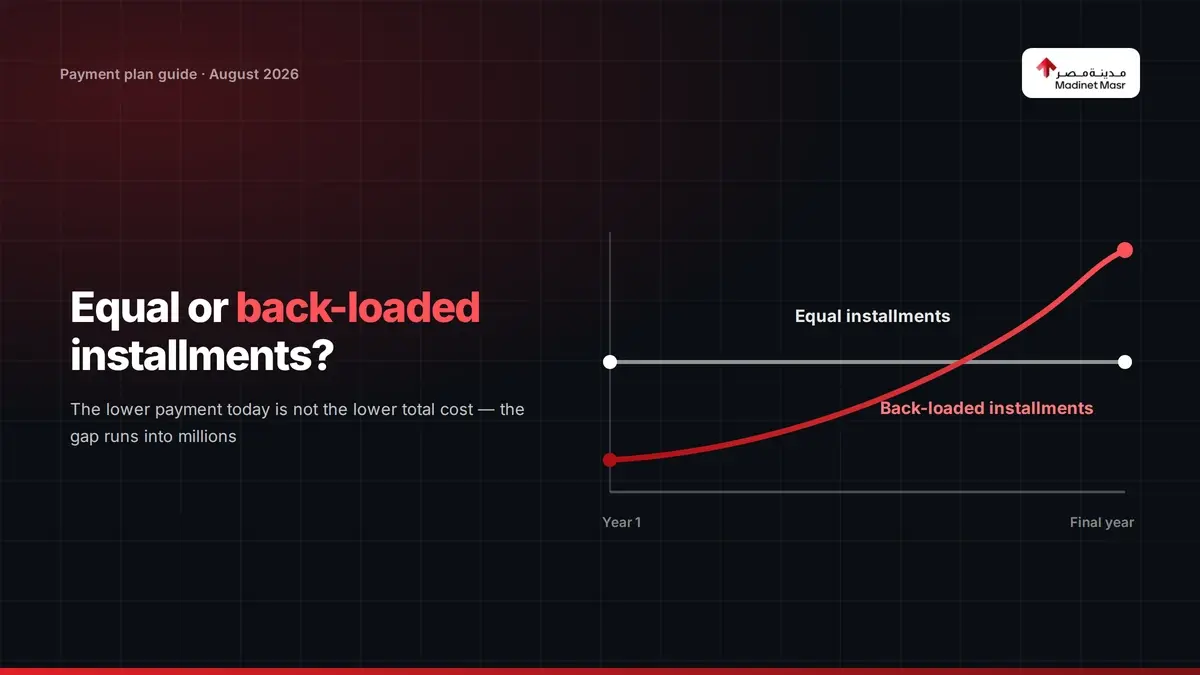
The difference, plainly
Equal installments: you pay the same amount every period from the first payment to the last. A EGP 12 million unit over 12 years means EGP 1 million a year, unchanged.
Back-loaded installments: the payment starts low and rises over time. You might begin at EGP 600,000 in year one and finish at EGP 1.5 million in the final year.
Developers offer the second structure to lower the entry barrier — it lets you buy a larger unit than your current budget supports, on the assumption your income grows.
Trap one: a fixed payment gets cheaper every year
This is the part most buyers miss. Inflation in Egypt currently runs at roughly 14.6% a year. That means the EGP 100,000 payment you make today is worth around EGP 50,000 in today's terms five years from now.
So a fixed payment on a long plan genuinely gets lighter over time, even though the number never changes — provided your income rises at something close to the inflation rate.
A back-loaded plan partly cancels that effect: it starts light but the nominal figure climbs, eating the natural relief inflation would otherwise hand you.

Trap two: the discount buried in the shorter plan
Here is where it gets practical. Egyptian developers tie the discount to the term: the shorter the plan, the larger the discount on the price.
A real market example: a project offering either a 15-year plan with equal installments, or a 12-year back-loaded plan with a 21% discount on the price.
The first has the lower monthly payment, so it looks cheaper. But calculate the true financing cost of each and the longer plan costs you roughly 18.4% a year, while the shorter plan with its discount costs about 16.4%.
The plan with the higher payment is, in fact, the cheaper one.
The method for working this out yourself is set out step by step in Egypt's real estate cash discount — what it actually saves you.
So which suits you?
Choose back-loaded if: your income is in a growth phase · you want a larger unit than your present budget allows · you have current commitments that will ease in two or three years.
Choose equal if: your income is fixed or you are near retirement · you want a stable financial plan with a number you know to the last day · you expect inflation to stay elevated, in which case the fixed payment keeps getting lighter.
In both cases: compare the plans on total price after discount, never on the first payment. On larger units that difference runs into millions.
One more thing: flexibility matters
Before signing, ask two questions.
Can I pay early? And if I settle a portion ahead of schedule, is there a discount for it? Some projects reward early settlement, which is a real advantage if your income improves unexpectedly.
Can I switch plans after signing? The answer is usually no — which is precisely why this decision is made once and needs to be calculated properly from the start.
Conclusion
The lower payment today does not mean the lower cost in the end. The right measure is total price after discount together with the implied financing cost, and both come from a handful of numbers you can simply ask for.
Madinet Masr's payment plans cover both structures — Talala offers either a 15-year equal plan or a discounted 12-year one, while Butterfly Compound and Sarai Compound run back-loaded plans from 1.5% down.
Request a side-by-side comparison on a specific unit and we will send you the full figures.