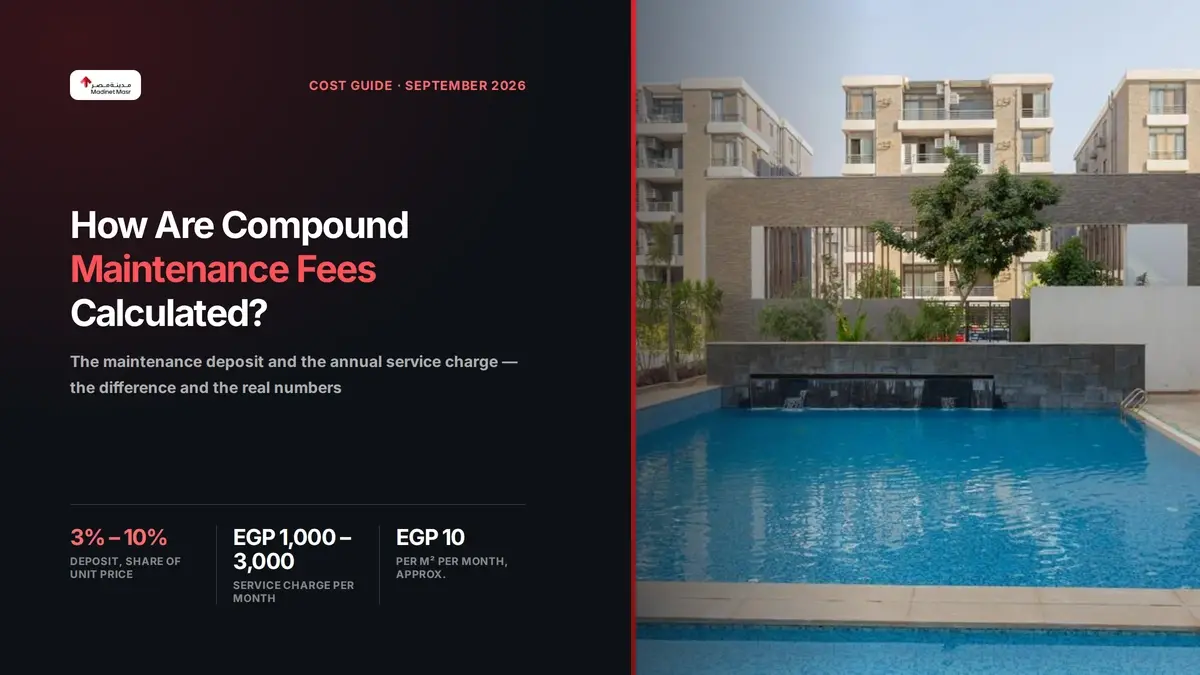
1. Not one charge — two entirely different ones
The first source of confusion is that two separate items get treated as one:
The maintenance deposit. A one-off amount paid at handover, intended to fund the maintenance of common areas and services until the owners' union is formed and takes over managing the project.
The annual service charge. A recurring yearly amount covering day-to-day operation: security, cleaning, lifts, lighting, landscaping, pools and management.
The first is a large one-time sum; the second is smaller but repeats for the life of the unit. Both belong in your calculation before you sign.

2. How the maintenance deposit is calculated
The deposit is set as a percentage of the unit price, and the prevailing ranges in the Egyptian market are:
Basic projects — 3% to 5% of the unit price.
Mid-range projects — 5% to 7%.
Premium compounds — 7% to 10%.
To make that concrete, take a EGP 5,000,000 unit: the deposit runs between EGP 150,000 and 250,000 on a basic project, 250,000 and 350,000 on a mid-range one, and 350,000 and 500,000 in a premium compound.
Half a million pounds is not a number to discover on handover day. It belongs in the budget from the beginning.
3. Is the deposit refundable?
This is where most of the confusion sits, so let me be plain about it:
In principle, yes. The concept behind the deposit is that it is held in trust to fund maintenance until the owners' union is formed and takes over running the project — typically two to three years after handover. At that point the remaining balance should transfer to the union or return to the owners, with any bank interest earned.
But it depends on the contract. What actually governs is what is written in your contract, not general practice. Some projects explicitly state that the deposit is non-refundable; others return it under conditions.
⚠️ So ask the representative this question literally — and ask for the answer in the contract: "Is this maintenance deposit refundable, when, and on what conditions?" If the answer is only verbal, treat it as non-refundable in your budgeting.
4. How the annual service charge is calculated
Three common methods, and it matters which one your project uses:
Per square metre. The most common, running at roughly EGP 10 per m² per month. A 150 m² unit therefore costs around EGP 1,500 a month.
A fixed monthly amount agreed with the management company regardless of unit size.
An annual amount collected in advance, or deducted from the maintenance deposit itself.
On actual cost: economy and mid-range projects run EGP 200 to 600 a month and typically cover only cleaning and basic lighting. Premium compounds reach EGP 1,000 to 3,000 a month, covering security, scheduled maintenance, facility management, clubs and pools.
5. The item everyone forgets — these fees rise
Service charges are not fixed for life. They track actual operating costs — security and cleaning salaries, electricity, spare parts — and all of those rise with inflation.
So the EGP 1,500 you pay today may be EGP 3,000 in five years. That is normal rather than exploitative, but it has to be in your calculation, particularly if you are buying to let — because these charges come straight off your net yield.
The correct yield calculation is annual rent minus service charges minus vacancy periods, not rent on its own.
6. The questions to ask before signing
Five questions that save you from surprises:
One: exactly how much is the maintenance deposit, and what is the percentage taken of — the original unit price or the discounted one?
Two: when is it payable — at contract or at handover? (Handover is the position that favours you, since the deposit funds a maintenance period that only begins after delivery — paying maintenance on something you have not received makes little sense.)
Three: is it refundable, under what conditions, and where exactly does the contract say so?
Four: how much is the annual service charge, and is it calculated per metre or as a fixed amount?
Five: what precisely does the charge cover, and what is excluded? (In some projects security and cleaning are included while the club and gym are billed separately.)
Conclusion
Maintenance fees are not a marginal item — the deposit alone can be 7% to 10% of the unit price in a premium compound, and the service charge stays with you for the life of the unit and rises over time.
The practical rule is simple: add the deposit to the unit price when comparing two projects, and subtract the service charge from the yield when calculating an investment. The cheapest advertised price is not always the cheapest true cost — the same principle set out in the cheapest compound in New Cairo.
If you are comparing projects now, you can see unit detail and payment plans for Sarai, Taj City and Talala — and ask us about the maintenance fees on any project; we will give you the figure as written in the contract.